
GLP certified.DAkkS accredited.
Dental & orthopaedic
material and device histology specialists.
Two credentials. Defined laboratory scopes.
GLP · Berlin test site · Category 9Tissue-sample processing, preparation of histological sections and histopathological diagnosis. Certificate issued 11 May 2026; valid until 10 May 2028.
Read the GLP certificateDAkkS · DIN EN ISO/IEC 17025:2018Accredited activities cover the listed ISO 10993-6 local-effects assessment and histology: microscopic evaluation and assessment of reactions. Certificate D-PL-22207-02-01, valid from 15 May 2026.
Read the accreditation and annexThe commissioned activities and responsibilities are defined in your study plan. These credentials apply to the stated Berlin laboratory scope; they do not certify a device or guarantee market approval.
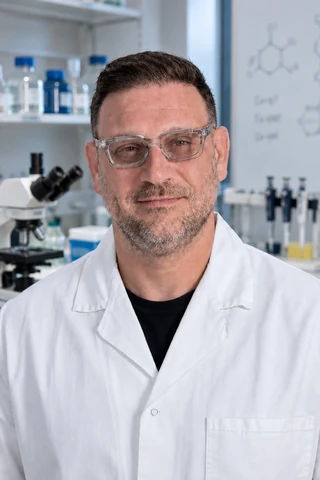
SCIENTIFIC LEADERSHIP
Prof. Dr.
Mike Barbeck
ACADEMIC EXPERIENCE
PREVIOUS INDUSTRY PARTNERS
THE NEXT QUESTION
01 / THE CONCEPT · ILLUSTRATION
Mineralised bone and osteoid are distinct.
02 / EXISTING TITANIUM ANALYSIS
A separate specimen—not the illustration’s source.
A DEFINED ENDPOINT
Contact is a length.
Bone area is an area.
Mineralised BIC (%) = mineralised bone in direct contact ÷ evaluable implant contour length × 100, within the agreed region of interest.
Keep osteoid contact separate. Define the contour, excluded artefacts and denominator before measuring. Tissue near the implant is not automatically in contact with it.
Interpretation & endpoint limits
BIC supports an assessment of osseointegration in the sampled plane. It does not measure fixation strength or prove clinical success. Area fractions in implant spaces require their own defined regions and denominators.
The existing analysis overlay has no supplied endpoint settings, colour legend or calibration. No BIC percentage is inferred from it. The illustrative endpoint definitions require scientific review before publication.
SELECTED HUMAN STUDIES
From a clinical question
to published evidence.
Clinical research co-authored by Prof. Dr. Mike Barbeck. These dental examples show different questions, methods and levels of evidence.
BONE REGENERATION · PRAMSTRALLER ET AL.
Ridge preservation.
Measured in tissue and dimensions.
Selective socket grafting in 30 extraction sites, with clinical, radiographic and histological assessment at 4–6 months.
Study context
Observational BARP study. The existing source review records 13 evaluable biopsies from 17 collected. Different protocols were used for intact and compromised sockets; no untreated control was included.
MAGNESIUM MEMBRANE · FRANKE ET AL.
Performance in practice.
Recovery and events recorded.
126 patients, 195 GBR procedures. A prospective observational evaluation of a resorbable magnesium barrier membrane.
Study context
Single-centre follow-up to three months assessed treatment success, wound dehiscence, clinically evident gas accumulation and reported recovery. This clinical study does not establish comparative superiority or long-term performance.
BONE SUBSTITUTES · KORZINSKAS ET AL.
Bone formation is one question.
The immune response is another.
Eight patients in a split-mouth comparison. Histomorphometry and immunohistochemistry examined two xenogeneic bone substitutes.
Study context
Six-month biopsies showed similar new-bone formation with differences in immune-cell responses. A small paired study; tissue-marker differences do not establish superior clinical outcomes. Mike’s author affiliation in this paper is University Medical Center Rostock.
Clinical evaluation, PMS/PMCF contributions and publication collaboration are scoped to your programme. A study demonstrates its observed findings; publication acceptance is independent.
 Material StudiesWithin Product Development
YOUR TEAM · DEVELOPMENT & DECISIONS
BERLINANALYTIX · STUDIES & FEEDBACK
YOUR TEAM
BERLINANALYTIX
Adapted from our industry-partner pathway. Study scope and timing are agreed for your programme.